ex15. Clustering with GPD Tail (Weights + Covariates)
Website workflow note. This page reflects the current exported clustering API built around dpmgpd.cluster(), predict(), summary(), and plot(). Last updated: 2026-03-19.
For the package-level theory and longer narrative, see the manuscript and the clustering discussion in the main package articles.
Clustering with a Spliced GPD Tail and Covariate-Dependent Weights
What you’ll learn
How to fit tail-aware clustering with dpmgpd.cluster().
How the type = "weights" dependence mode uses covariates to change cluster prevalence (mixture weights), while keeping component likelihood structure shared.
How to use predict() to obtain labels and a posterior similarity matrix (PSM), and how to interpret the label/PSM plots.
Purpose (in one sentence)
Fit a tail-aware clustering model where covariates affect cluster prevalence through mixture weights (type = "weights"), and the component likelihood is a spliced bulk + GPD tail model.
$K_star
[1] 5

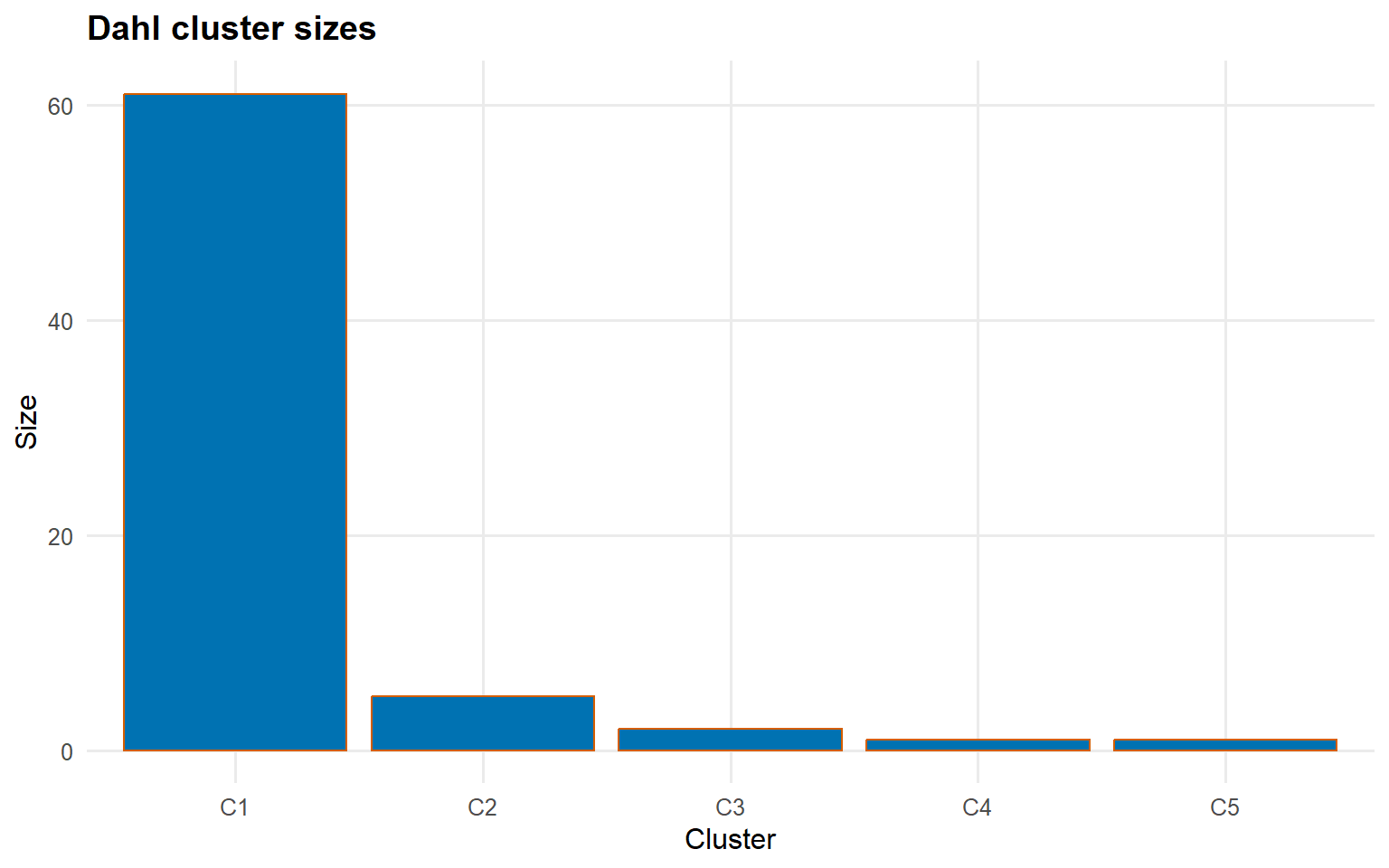
$cluster_sizes

 1  2  3  4  5
61  5  2  1  1

$cluster_profiles
  cluster  n    y_mean      y_sd      x1_mean     x1_sd     x2_mean     x2_sd
1      C1 61 1.9519186 1.1309051 -0.008098264 0.9277559  0.04763821 0.5634605
2      C2  5 1.5332865 0.8451246  0.465058447 0.8558037  0.17916220 0.3363054
3      C3  2 0.7717176 0.1199999 -0.395431116 1.1312839 -0.55624407 0.2742523
4      C4  1 1.9395389        NA  1.241187447        NA -0.04143591        NA
5      C5  1 5.2783434        NA  1.079272215        NA -0.28493860        NA
     x3_mean     x3_sd certainty_mean certainty_sd
1 -0.0217340 0.9401597      0.3124220   0.03614309
2 -0.3689271 1.0437381      0.2656916   0.02948265
3  0.9168566 0.5688655      0.3065634   0.01406759
4  1.2865362        NA      0.3995354           NA
5 -0.8084690        NA      0.4036634           NA

$certainty
   Min. 1st Qu.  Median    Mean 3rd Qu.    Max.
 0.2209  0.2919  0.3205  0.3115  0.3383  0.4037

$source
[1] "train"

$burnin
[1] 0

$thin
[1] 1

attr(,"class")
[1] "summary.dpmixgpd_cluster_fit" "list"
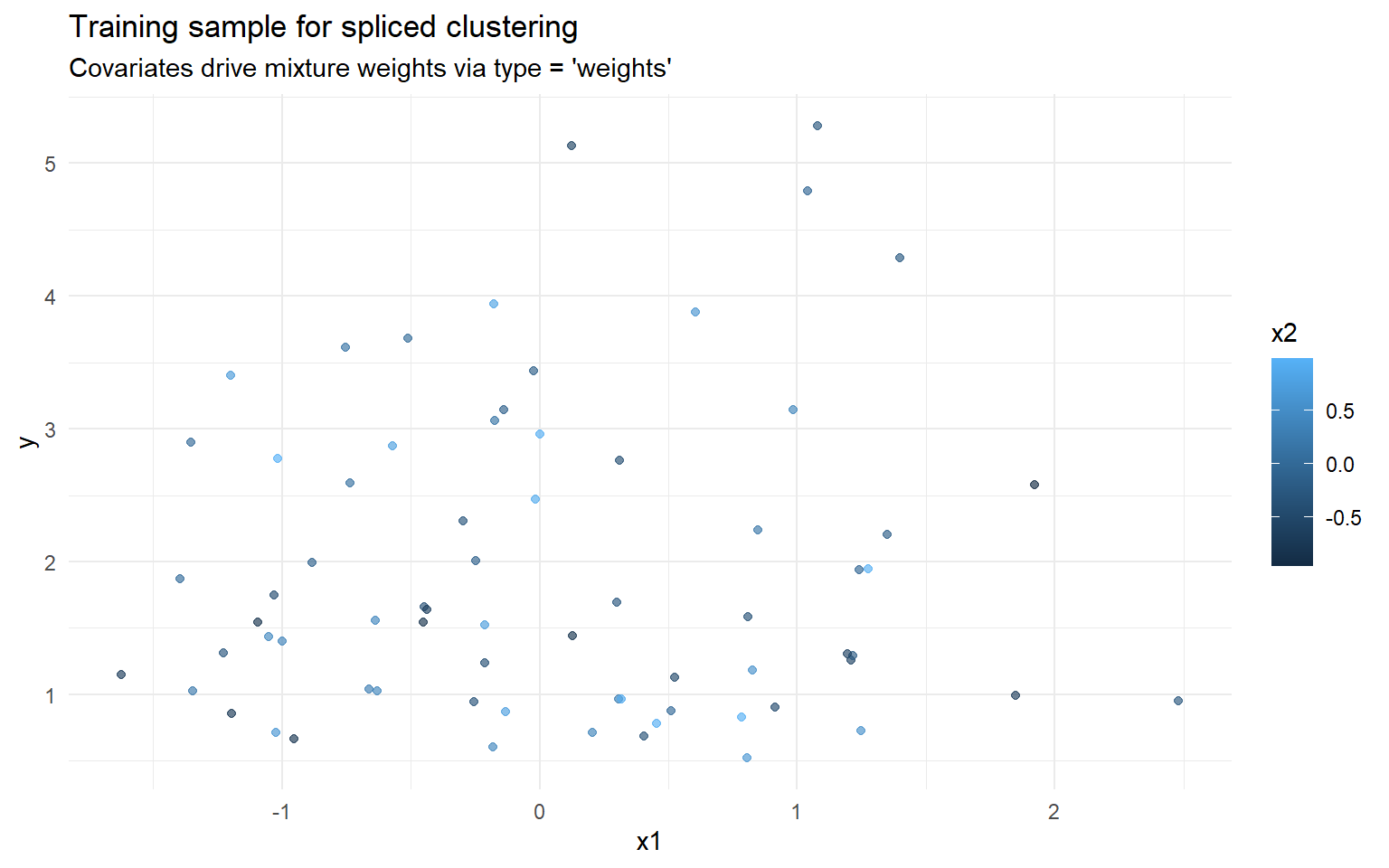
This clustering configuration uses the formula/data-frame interface directly. Because type = "weights", covariates enter the gating model for cluster membership, while the spliced bulk-tail likelihood captures upper-tail differences inside each component.
Training Labels and Posterior Similarity Matrix
Code
cluster_psm_gpd <-predict(fit_cluster_gpd, type ="psm")cluster_train_gpd <-predict(fit_cluster_gpd, type ="label", return_scores =TRUE)train_summary_gpd <-summary( cluster_train_gpd,vars =c("y", "x1", "x2", "x3"),top_n =5)train_sizes_tbl <-tibble(cluster =paste0("C", names(train_summary_gpd$cluster_sizes)),n =as.integer(train_summary_gpd$cluster_sizes))train_sizes_tbl
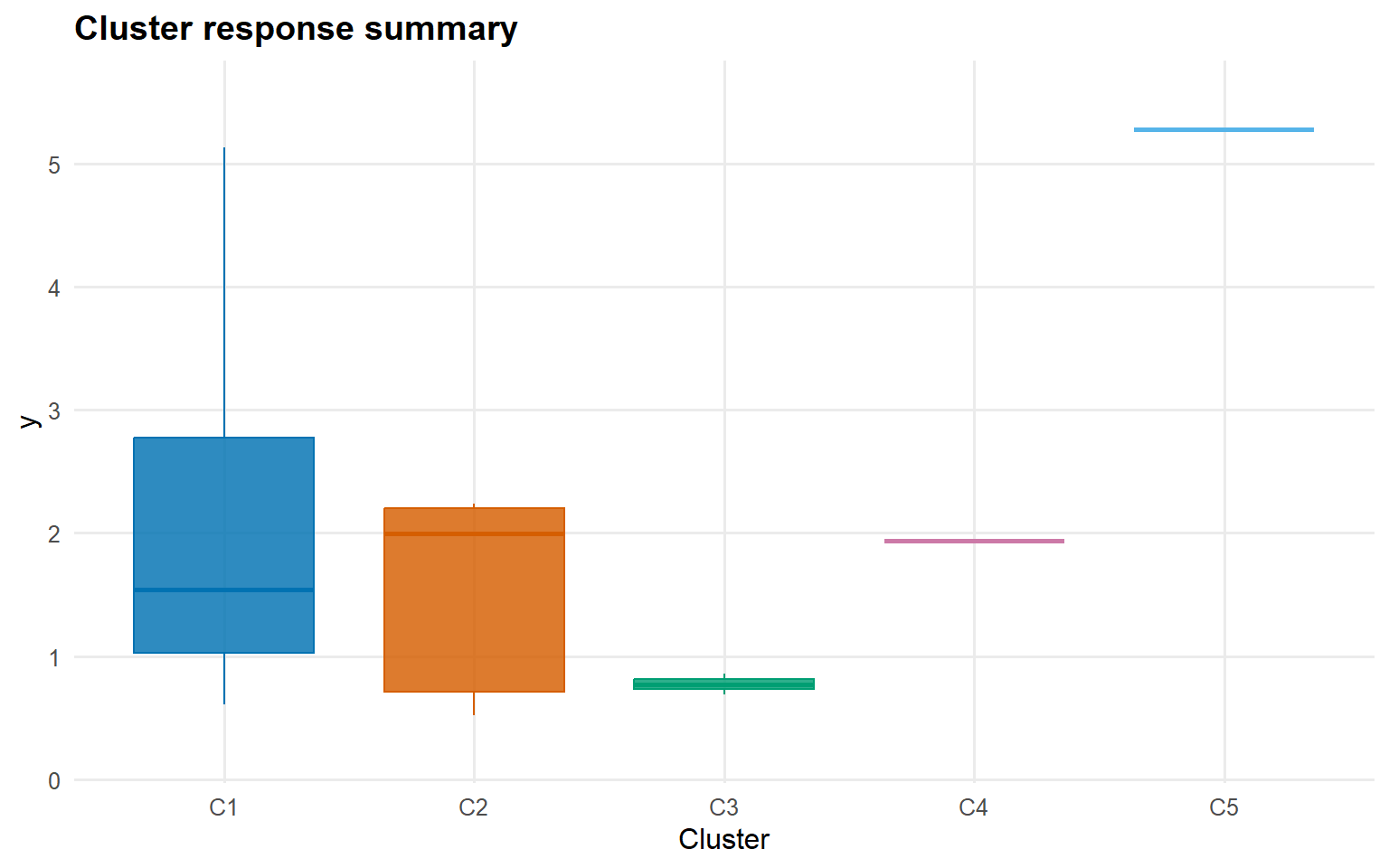
plot(cluster_train_gpd, type ="summary", top_n =5)
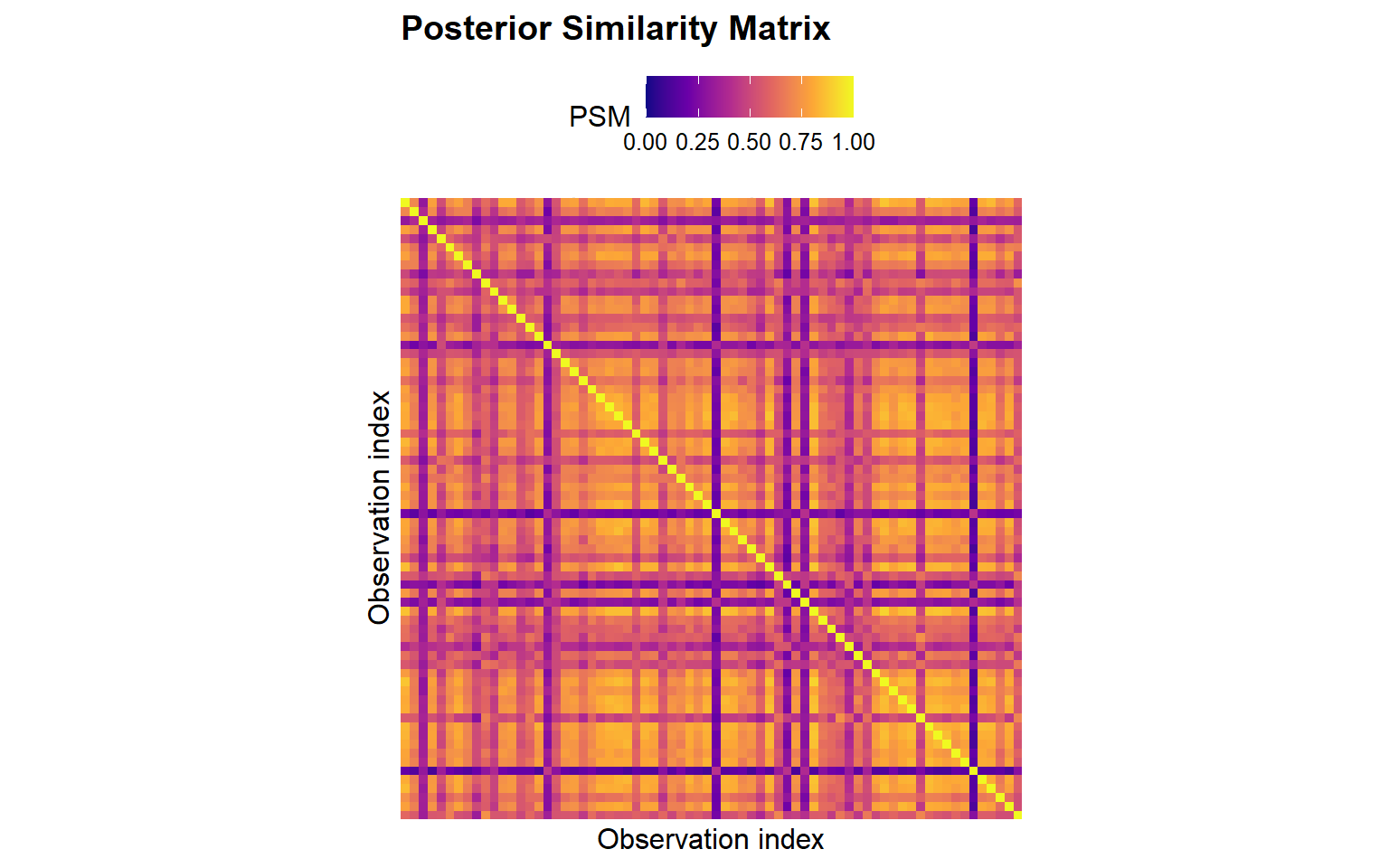
The PSM summarizes posterior co-clustering probabilities on the training sample, while the training label object gives the Dahl representative partition together with assignment scores and cluster-level summaries.
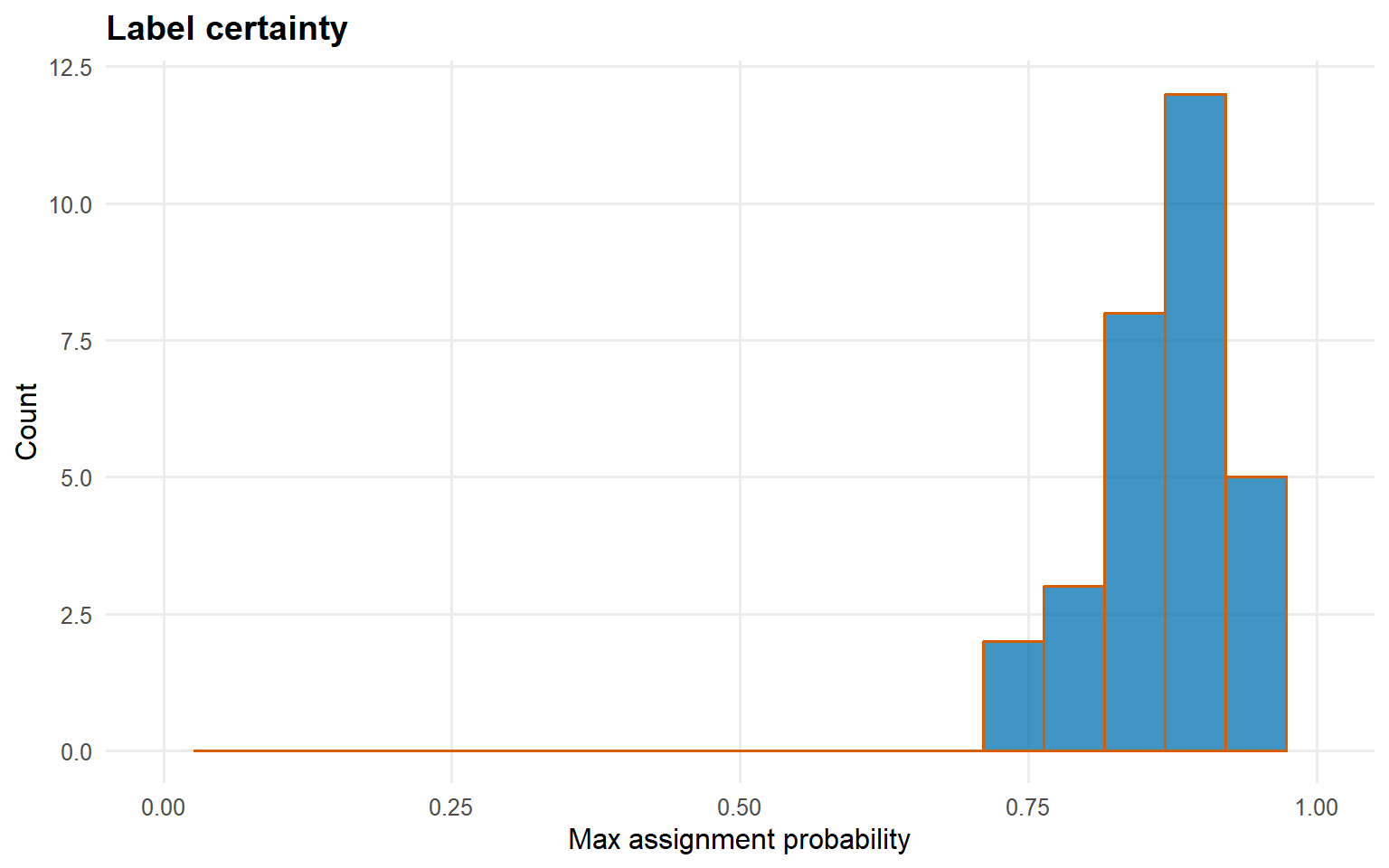
predict(..., newdata = ..., type = "label") maps held-out observations into the space of the representative training clusters. The returned score matrix can be summarized either numerically or with the built-in certainty plot above.
Takeaways
dpmgpd.cluster() is the current wrapper for tail-aware clustering.
type = "weights" is appropriate when covariates should change cluster prevalence rather than cluster-specific kernel parameters.
The standard post-fit workflow is predict(..., type = "psm"), predict(..., type = "label"), then summary()/plot() on the returned cluster objects.
The next page contrasts this with a bulk-only clustering model where covariates enter through parameter links instead of weights.