CausalMixGPD
  • Home
  • Roadmaps
    • Website roadmap
    • Package roadmap
  • Start
    • Start Hub
    • Roadmap
    • Usage Diagrams
    • Start Here
    • Basic Compile and Run
    • Backends and Workflow
    • Troubleshooting
  • Tracks
    • Quickstart
    • Modeling (1-arm)
    • Causal
    • Clustering
    • Kernels & tails
    • Customization
  • Examples
  • Kernels
  • Advanced
  • Developers
  • Reference
    • Reference hub
    • Function reference by job
  • News
  • Cite
  • Coverage
  • API Reference

ex04. Unconditional DPMGPD (SB Backend)

Website workflow note. This page reflects the current exported API and recommended wrapper-first usage. Last updated: 2026-02-19.

For the full package narrative, see the main package vignettes (basic, unconditional, conditional, and causal).

Unconditional CausalMixGPD: Stick-Breaking (SB) Backend with Tail Augmentation

Purpose: Demonstrate the stick-breaking backend (components = J) while augmenting the extreme tail with a GPD. This mirrors the CRP+GPD pipeline (ex03) but highlights the fixed-truncation behavior for bulk components.

What you’ll learn

  • How to combine SB truncation (components = J) with GPD tail augmentation (GPD = TRUE).
  • What stays invariant across backends in the wrapper-first workflow: bundle() → dpmgpd() → predict()/plot().
  • How to sanity-check tail impact using density/survival/high-quantile predictions.

When to use this template

  • You want tail augmentation and also want the computational predictability of a fixed-component SB mixture.
  • You want an explicit tuning knob (components) while iterating on model structure.

Next steps

  • Compare against CRP+GPD (ex03) to see how partition flexibility affects uncertainty.

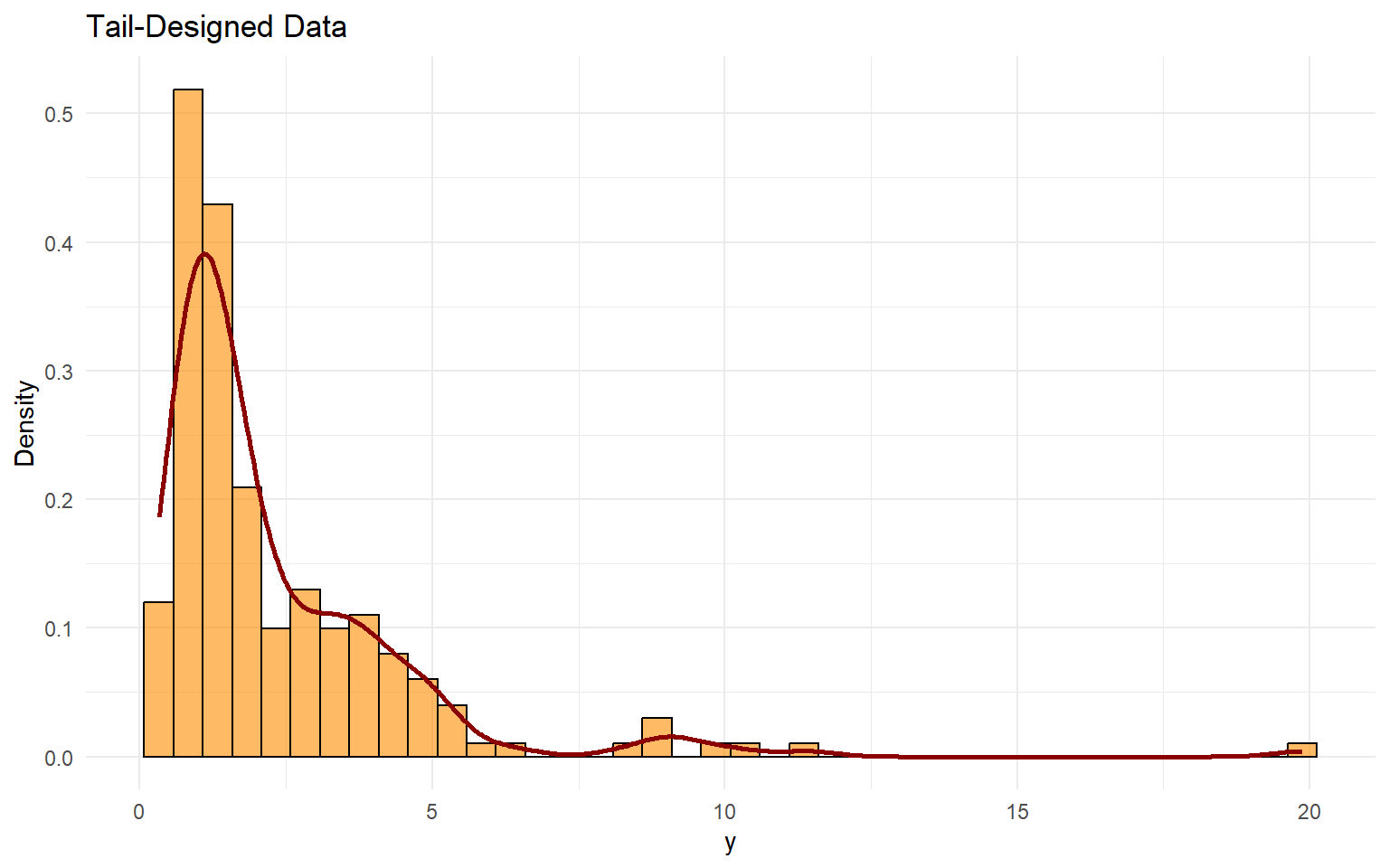
Data Setup

Code
# Tail-heavy data
data("nc_pos_tail200_k4")
y_tail <- nc_pos_tail200_k4$y

summary_tbl <- tibble(
  statistic = c("N", "Mean", "SD", "Min", "Max"),
  value = c(length(y_tail), mean(y_tail), sd(y_tail), min(y_tail), max(y_tail))
)

df_data <- data.frame(y = y_tail)

p_raw <- ggplot(df_data, aes(x = y)) +
  geom_histogram(aes(y = after_stat(density)), bins = 40, fill = "darkorange", alpha = 0.6, color = "black") +
  geom_density(color = "darkred", linewidth = 1) +
  labs(title = "Tail-Designed Data", x = "y", y = "Density") +
  theme_minimal()

print(p_raw)

# A tibble: 5 × 2
  statistic   value
  <chr>       <dbl>
1 N         200    
2 Mean        2.33 
3 SD          2.30 
4 Min         0.328
5 Max        19.9  

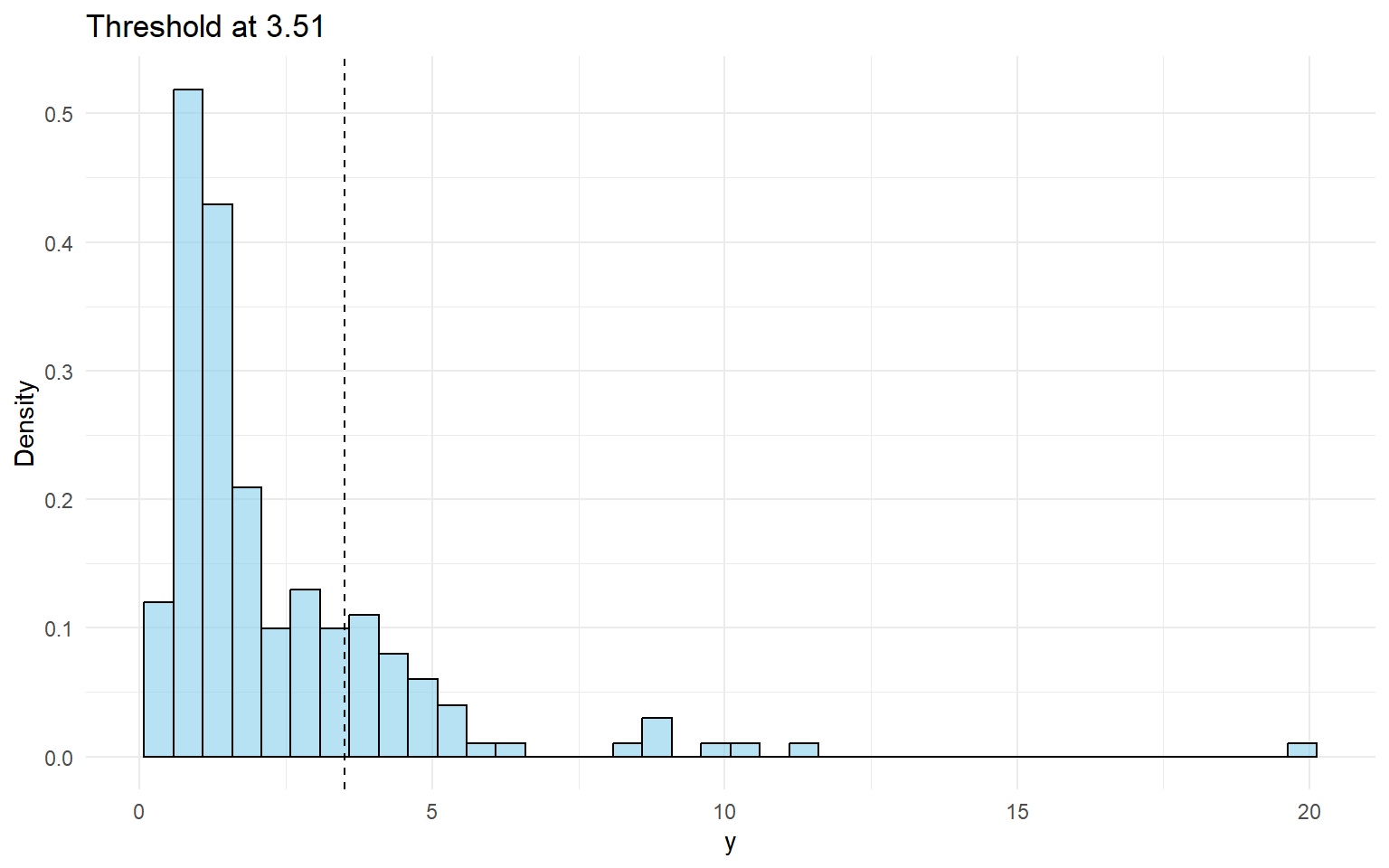
Threshold Selection

Code
thresholds <- quantile(y_tail, c(0.70, 0.75, 0.80, 0.85))
u_threshold <- thresholds["80%"]

ggplot(df_data, aes(x = y)) +
  geom_histogram(aes(y = after_stat(density)), bins = 40, fill = "skyblue", alpha = 0.6, color = "black") +
  geom_vline(xintercept = u_threshold, linetype = "dashed", color = "black") +
  labs(title = paste("Threshold at", round(u_threshold, 2)), x = "y", y = "Density") +
  theme_minimal()


Model Specification & Bundle

This follows the same structure as the SB bulk-only vignette (ex02): build a bundle with bundle(), run MCMC, then use the S3 predict() + plot() helpers. Compared with ex03 (CRP+GPD), here we keep the stick-breaking backend and use a Gamma bulk kernel with a lognormal threshold prior, then contrast it with a bulk-only Laplace fit.
Code
bundle_sb_gpd <- bundle(
  y = y_tail,
  kernel = "gamma",
  backend = "sb",
  GPD = TRUE,
  components = 5,
  param_specs = list(
    gpd = list(
      threshold = list(
        mode = "dist",
        dist = "lognormal",
        args = list(meanlog = log(max(u_threshold, .Machine$double.eps)), sdlog = 0.25)
      )
    )
  ),
  mcmc = mcmc
)

Running MCMC

Code
fit_sb_gpd <- load_or_fit("ex04-unconditional-dpmgpd-sb-fit_sb_gpd", dpmgpd(bundle_sb_gpd))
summary(fit_sb_gpd)
MixGPD summary | backend: Stick-Breaking Process | kernel: Gamma Distribution | GPD tail: TRUE | epsilon: 0.025
n = 200 | components = 5
Summary
Initial components: 5 | Components after truncation: 3

Summary table
  parameter  mean    sd q0.025 q0.500 q0.975    ess
 weights[1] 0.538  0.11  0.346  0.522  0.707   3.37
 weights[2] 0.253 0.063  0.145  0.256  0.351  6.253
 weights[3] 0.139 0.062   0.05  0.126  0.245  3.059
      alpha 1.055 0.417  0.446   1.02  1.971 20.348
 tail_scale 1.981 0.609  1.133  1.833  3.626 12.737
 tail_shape 0.151 0.106 -0.093  0.159  0.349 11.938
  threshold 3.142 0.787   2.39  2.856  5.463  6.018
   shape[1] 4.988 1.095  2.685  4.862  8.108 11.418
   shape[2] 3.051 1.284   1.43  2.744  6.212   9.32
   shape[3]  2.45 1.178  1.108  2.058  5.212  10.48
   scale[1] 0.299 0.204  0.142  0.246  0.993 13.017
   scale[2]  1.86  1.52  0.169  1.323  5.145  3.471
   scale[3]  2.88 1.384  1.175  2.577  6.404 50.099
Code
params_sb_gpd <- params(fit_sb_gpd)
params_sb_gpd
Posterior mean parameters

$alpha
[1] 1.055

$w
[1] 0.5381 0.2532 0.1394

$shape
[1] 4.988 3.051 2.450

$scale
[1] 0.2985 1.8600 2.8800

$tail_scale
[1] 1.981

$tail_shape
[1] 0.1508

Posterior Predictions

Code
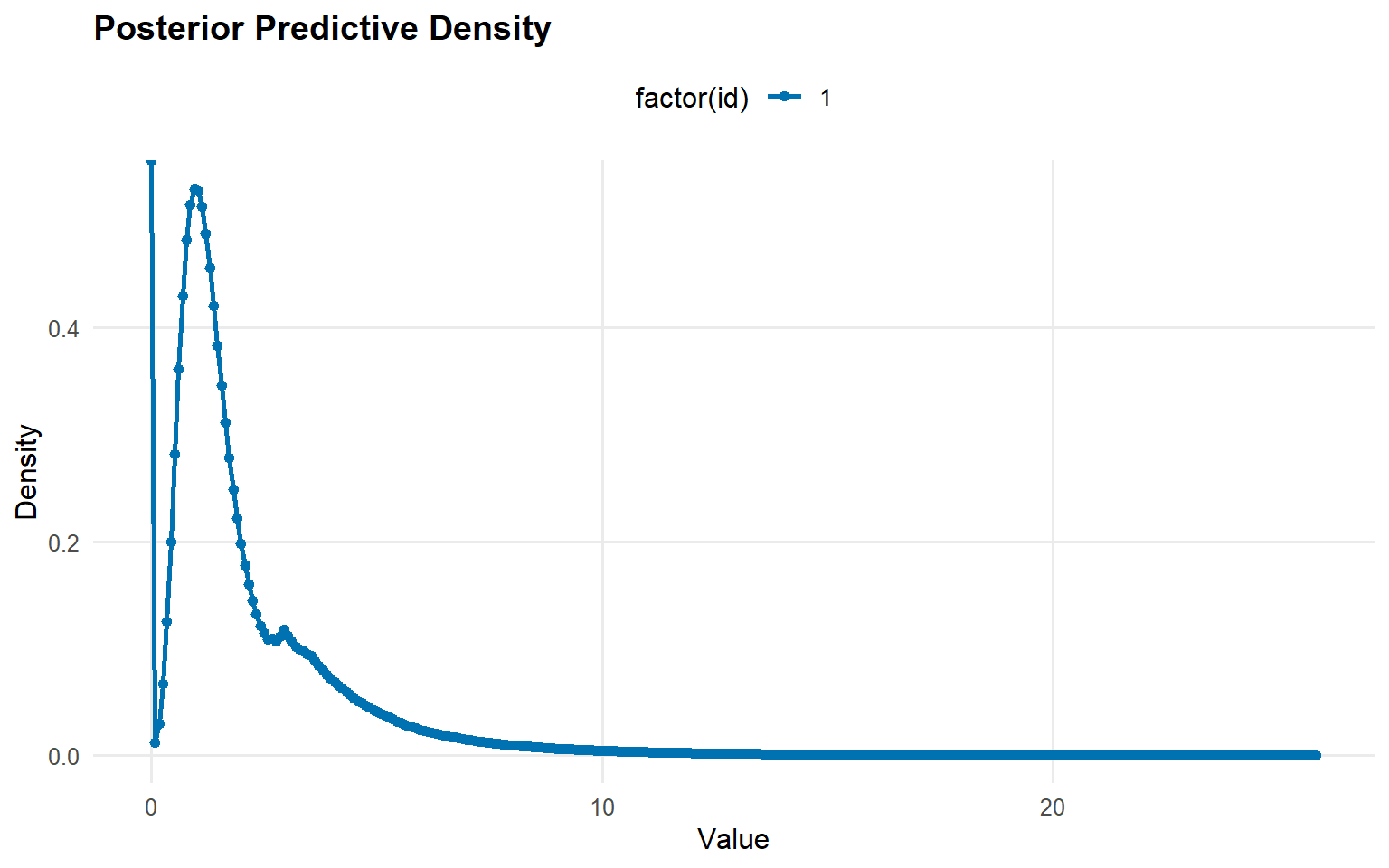
y_grid <- seq(0, max(y_tail) * 1.3, length.out = 300)
pred_density <- predict(fit_sb_gpd, y = y_grid, type = "density")
plot(pred_density)

Code
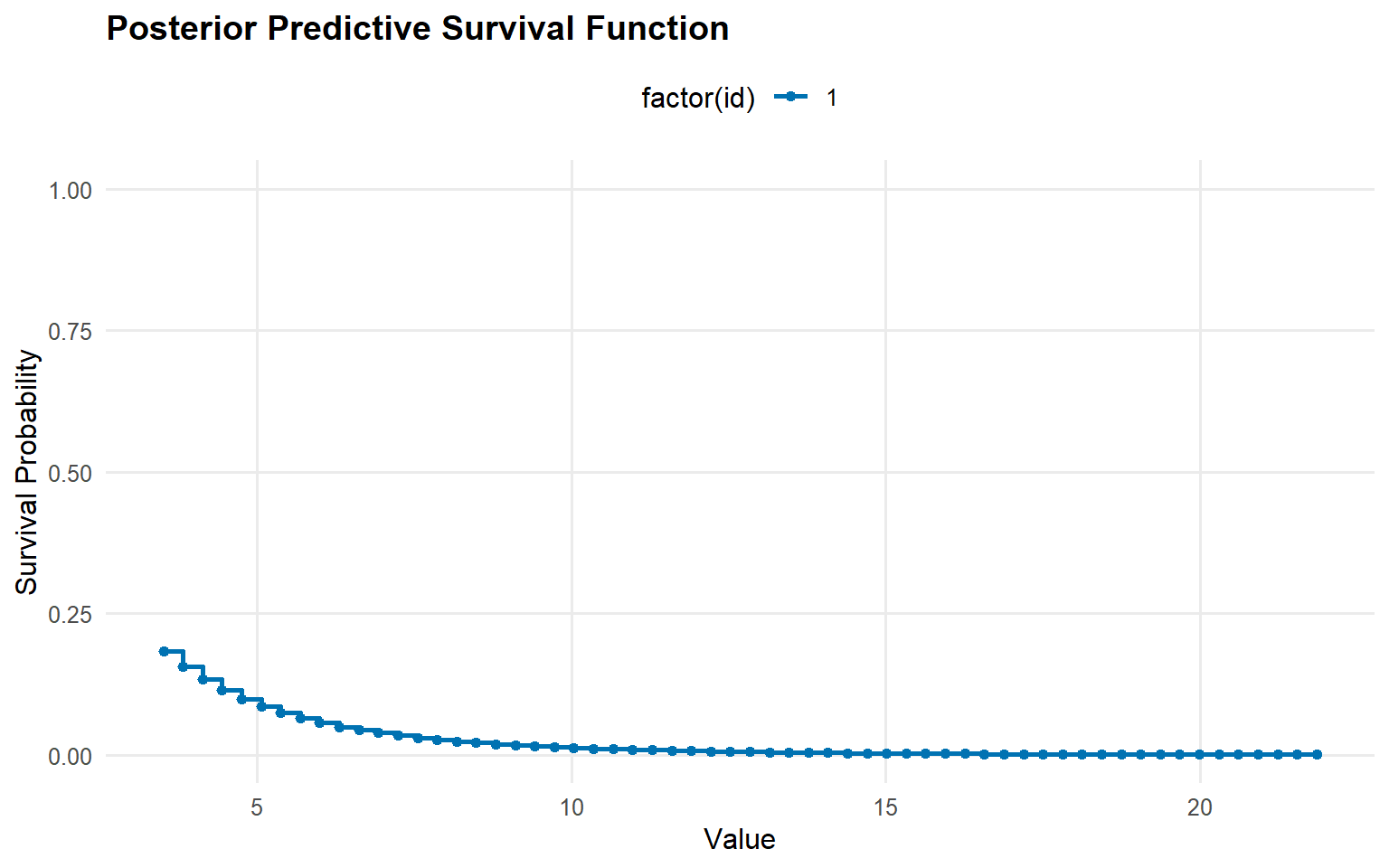
y_surv <- seq(u_threshold, max(y_tail) * 1.1, length.out = 60)
pred_surv <- predict(fit_sb_gpd, y = y_surv, type = "survival")
plot(pred_surv)

Code
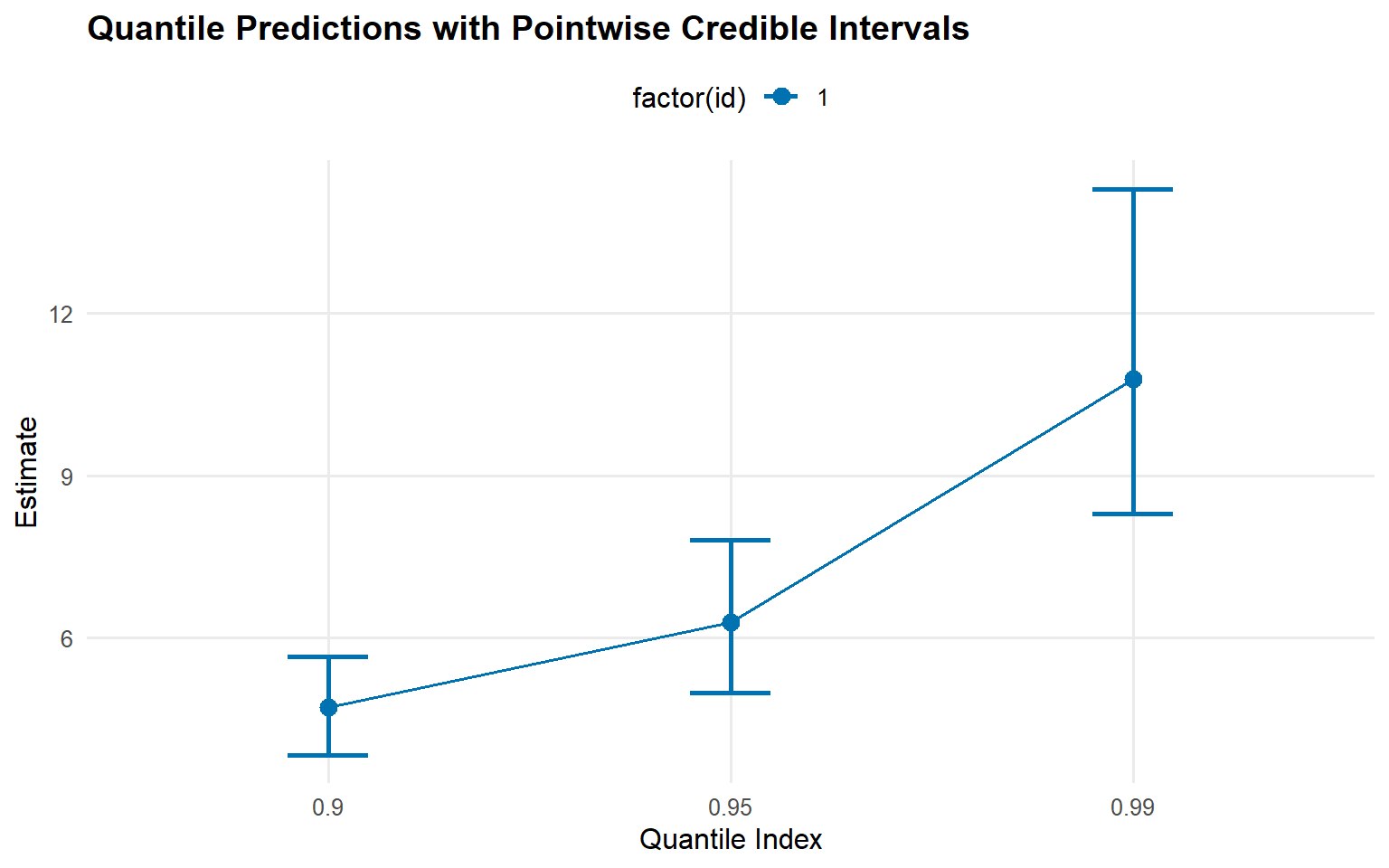
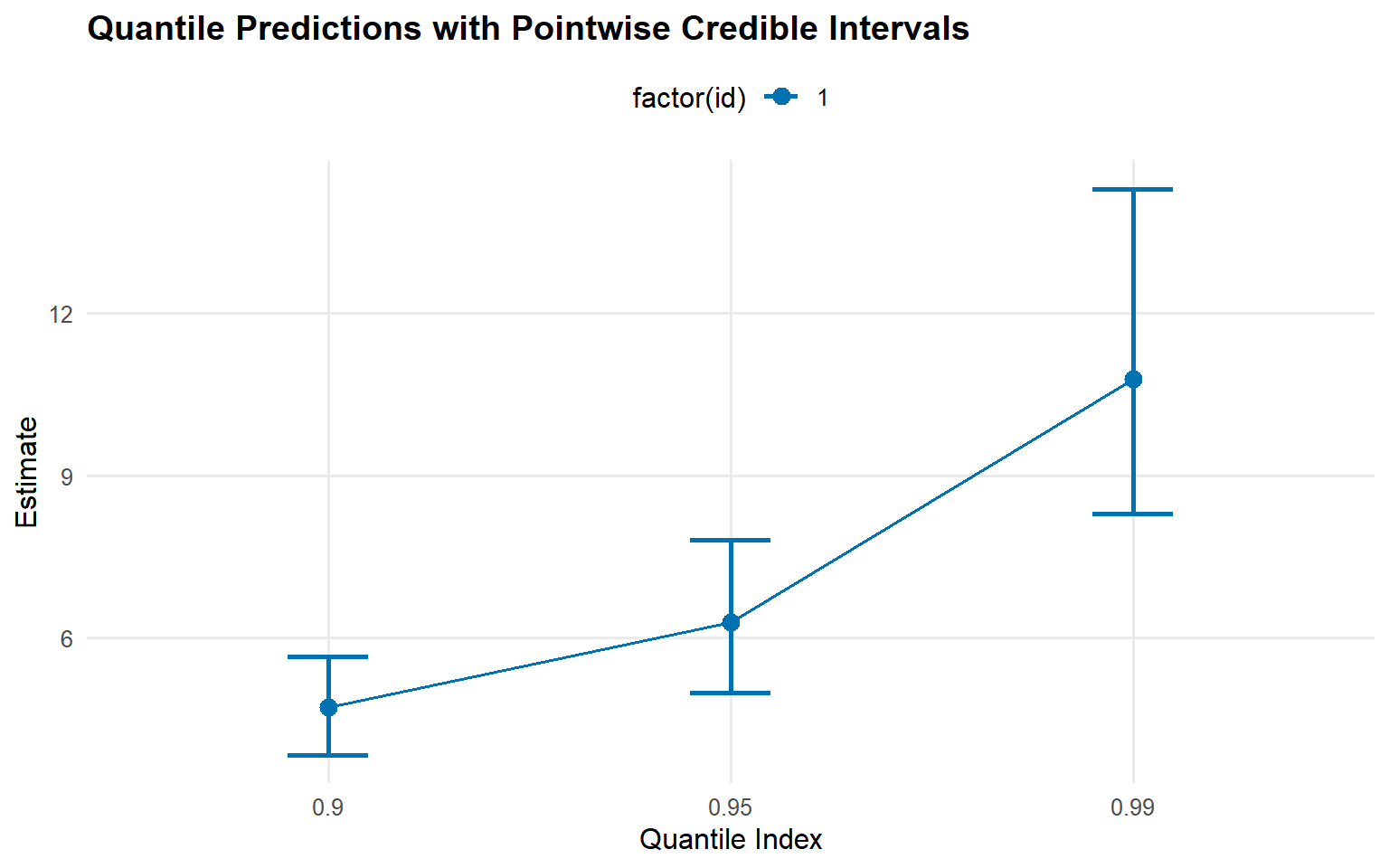
quant_probs <- c(0.90, 0.95, 0.99)
pred_quant <- predict(fit_sb_gpd, type = "quantile", p = quant_probs, interval = "credible")
plot(pred_quant)


Tail vs Bulk Comparison

Code
bundle_sb_bulk <- bundle(
  y = y_tail,
  kernel = "laplace",
  backend = "sb",
  GPD = FALSE,
  components = 5,
  mcmc = mcmc
)
fit_sb_bulk <- load_or_fit("ex04-unconditional-dpmgpd-sb-fit_sb_bulk", dpmix(bundle_sb_bulk))

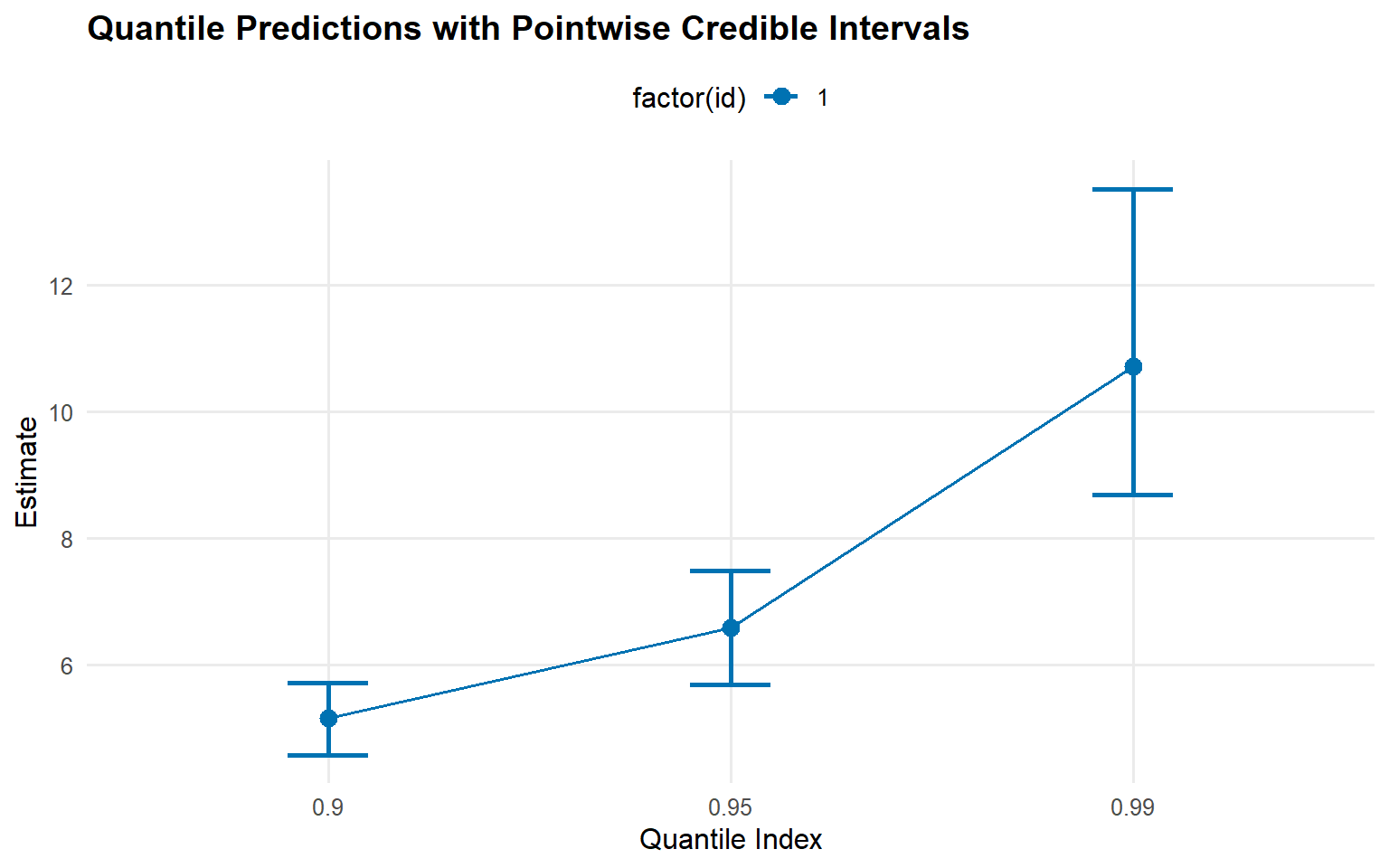
bulk_quant <- predict(fit_sb_bulk, type = "quantile", p = quant_probs)
t_quant <- predict(fit_sb_gpd, type = "quantile", p = quant_probs)

bind_rows(
  bulk_quant$fit %>% mutate(model = "Bulk-only"),
  t_quant$fit %>% mutate(model = "Bulk + GPD")
) %>%
  select(any_of(c("model", "index", "estimate", "lwr", "upr", "lower", "upper")))
       model index  estimate    lower     upper
1  Bulk-only  0.90  5.157292 4.578650  5.722606
2  Bulk-only  0.95  6.583909 5.690428  7.484298
3  Bulk-only  0.99 10.716616 8.691089 13.520645
4 Bulk + GPD  0.90  4.715481 3.840533  5.662347
5 Bulk + GPD  0.95  6.298667 4.983781  7.807621
6 Bulk + GPD  0.99 10.771050 8.290001 14.287834
Code
plot(bulk_quant)

Code
plot(t_quant)


Diagnostics

Code
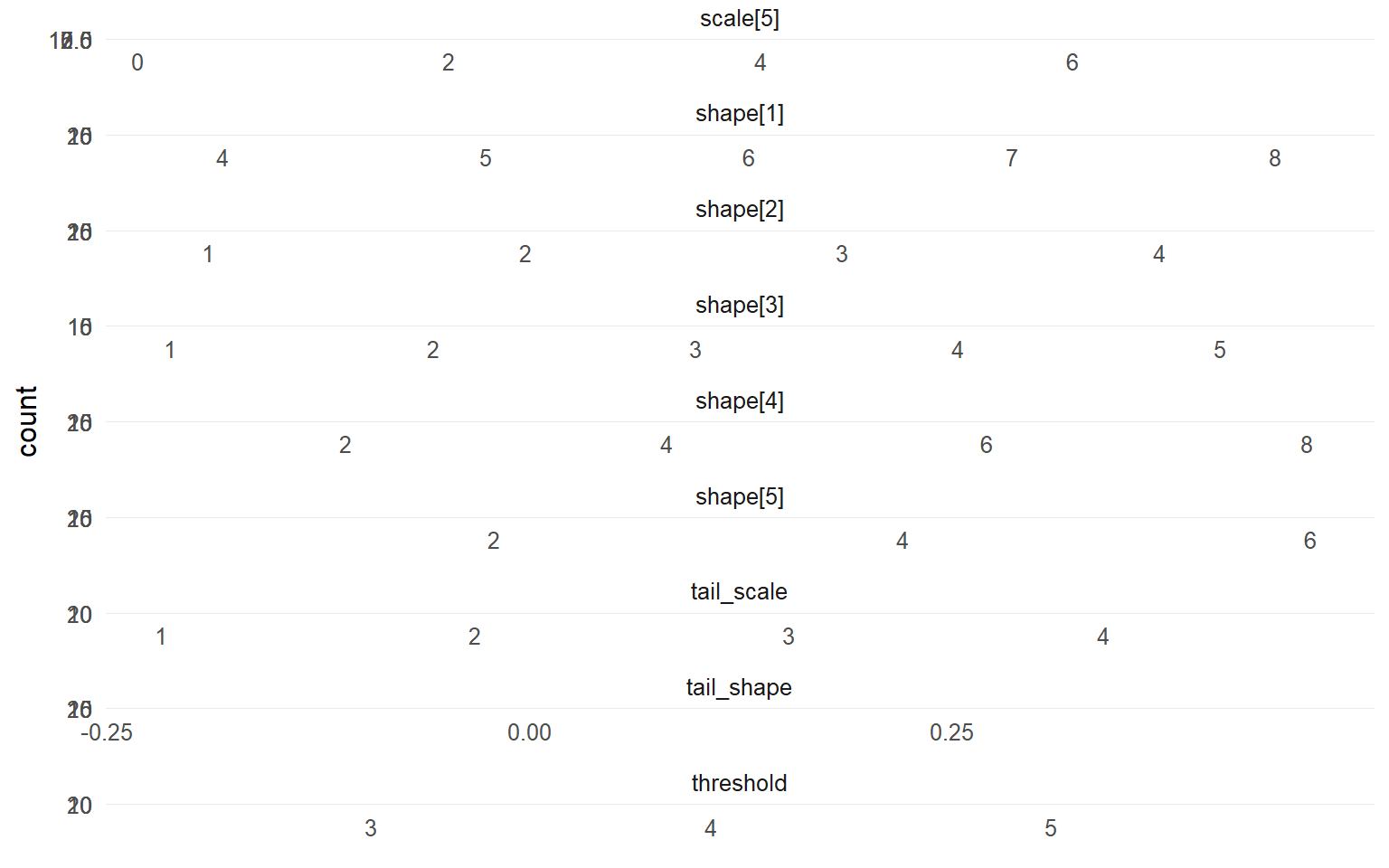
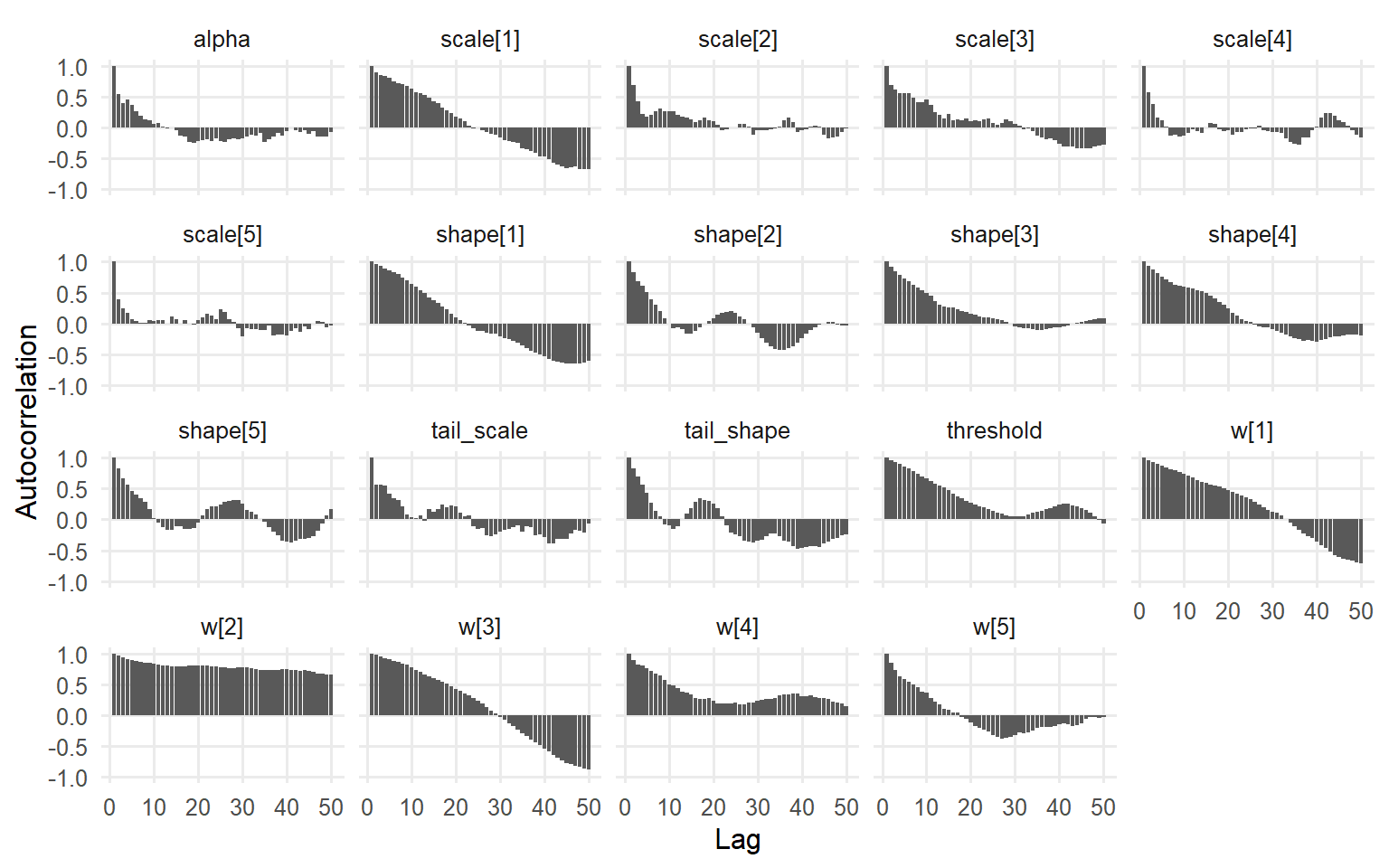
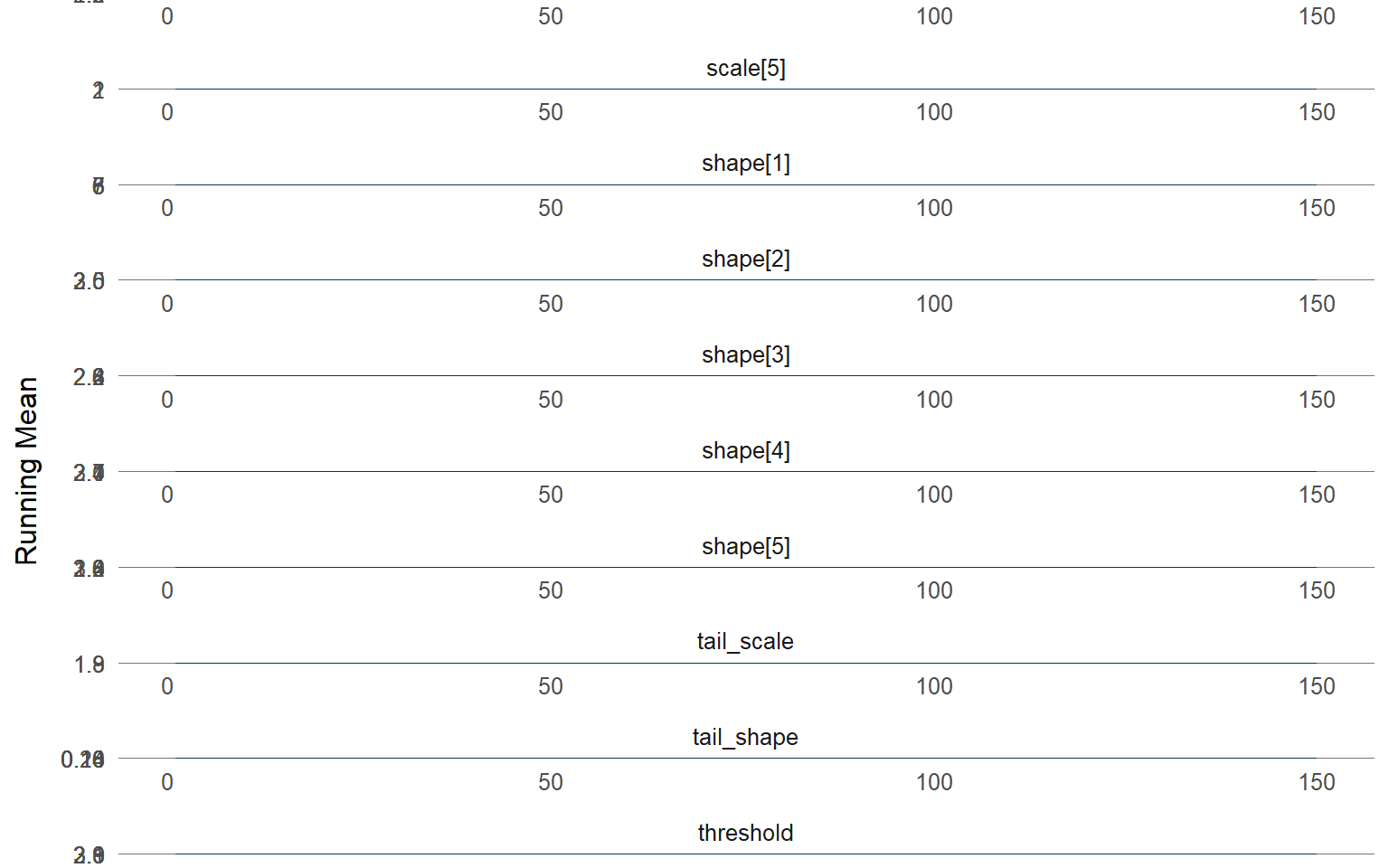
plot(fit_sb_gpd, family = c("histogram", "autocorrelation", "running"))

=== histogram ===


=== autocorrelation ===


=== running ===


Key Takeaways

  • Stick-breaking truncation fixes the number of bulk components but still flexibly models the tail via GPD.
  • Posterior predict() + plot() workflows visualize densities, survival probabilities, and posterior-mean extreme quantiles.
  • Comparing bulk-only vs GPD-augmented quantiles reveals how tail augmentation shifts the 95-99% levels.
  • Next: conditional DPM (ex05-ex08) to explore covariate effects before moving to causal regimes.

Workflow Navigation

  • Previous: ex03-unconditional-dpmgpd-crp
  • Next: ex05-conditional-dpm-crp
  • Workflow index: Roadmap
  • Practical entry: Examples

Prereqs

  • Required packages and data for this page are listed in the setup chunks above.

Outputs

  • This page renders model fits, diagnostics, and summary artifacts generated by package APIs.

Interpretation

  • Canonical concept page: Model Umbrella
  • Treat this page as an application/example view and use the canonical page for core definitions.

Next

  • Continue to the linked canonical concept page, then return for implementation-specific details.
(c) CausalMixGPD - Bayesian semiparametric modeling for heavy-tailed data
- - Cite - API - GitHub